Your next role isn't one you apply for - it's one you get found and referred into
Once you're at the WEMBA level, the game changes. It's not just job boards anymore - it's headhunters, internal networks, and showing people you're ready for the next step even if the title isn't on your resume yet. So tonight was built around the three things holding you back: understanding the headhunter mindset, cracking referrals, and reframing your story.
In Shannon and Megan's pre-session survey, what did 50% of you name as your #1 career priority?
C) A bigger role somewhere new. Aly and Cherry called it right away - you know your classmates well!
Moving up where you are and pivoting industries matter too, but the high-contrast jump to a bigger role at a new company is what tonight was built around.
How many resumes is the average recruiter juggling at any one time in 2026?
C) A whopping 10,000. Susie went for C, and sadly for the recruiters of the world, it's true.
AI has driven the cost of one more application down to basically zero, so volume has more than doubled in a couple of years - while recruiters are among the first cut in every round of layoffs. Fewer recruiters, way more applications. And because people are less likely to fib on a public LinkedIn profile than a private resume, LinkedIn is where they go looking for someone real.
Get Reframed
Use ikigai and AI to turn your superpowers into a specific job title - then test it with the Whartonites already doing it.
Demo: Samir's ikigaiGet Found
Put the title headhunters search for in your headline, signal quietly with recruiters-only Open to Work, and close your keyword gaps.
Demo: Jasmine's makeoverGet Referred
A referral is a 10x advantage. Build one at any company - even a fortress like Blackstone where you know nobody.
Demo: Angela at BlackstoneTap any step to jump to its copy-paste prompts.
Skate to where the puck is headed
Most profiles describe where you are today. Like Wayne Gretzky, the great one himself, you want to skate to where you're going - and recruiters search for exactly that.
When recruiters search for you on LinkedIn, what do they start with: your degree, your alma mater, or a job title?
C) A specific job title. Every Whartonite in the chat said C, and Kevin Tsai explained why: the title tells them what you do and your seniority.
"Are you focused on my role? If not, I need to find someone who is." It sounds cold, but it's what recruiters have to do every moment of the day.
See the original ikigai diagram. To build a great next stage of your career, find harmony between who you are and what the world needs.
Samir's ikigai, live (from the train!)
His superpower: he can connect the dots and see the big picture - key not just for getting the job done, but for seeing where the job is headed. His motivator: seeing execution get done, especially on challenging tasks, on time.
Ten titles came back, and number two jumped out: Chief of Staff. A role we've all heard of but few of us have actually done.
So we searched Wharton and Penn alumni for "chief of staff" - and found hundreds, including Jeffrey, chief of staff to the CPO at Asana. Then the mutual connections who could vouch for Samir. 🔥
Find your path - and the Quaker who's walked it
- Run Prompts 1 and 2 to turn your superpowers into ten specific job titles. Recruiters aren't searching for "dot connectors" - they're filling COO and CMO roles.
- Search LinkedIn People with both The Wharton School and University of Pennsylvania in the Schools filter (get credit for both affiliations), then type the role as your keyword.
- Skip the $50-a-month InMail. LinkedIn's dirty little secret: tons of users, very little usage. Jeffrey checks his LinkedIn inbox every three or four months.
- Go where professionals check every three minutes: email. Prompt 3 cracks the company's format.
- Beat stranger danger: click Mutual connections and ask a friend of a friend to vouch for you. Social proof beats even the Wharton name.
- Before the chat, click the three dots on the alum's profile > Save to PDF, upload it with your ikigai, and run Prompt 4.
Not as crystal clear on your strengths as Samir? Any AI you've been using for a while is a really good digital mirror. Know thyself, as Socrates said.
When we were younger we assumed there was one dream job. It turns out there are lots - you just have to find the one that fits where you want to go next.
AI goes out on the web and finds the pattern, so you land in the inbox that actually gets read.
"Do you like your job?" is fine for a first-year. As EMBAs, your bar is higher: triangulate you, the alum and the role, and test the waters before you dive in.
Get those headhunters focused on you
Headhunters live and breathe LinkedIn even more than corporate recruiters. Econ 101: they only get paid when they place an amazing candidate. So it's not "let me find someone good" - it's "I must find someone good."
With 1.3 billion profiles and no time, how do headhunters find candidates fast?
B) The keywords on your profile. Not your Wharton classes, not your grades. Yasir Iqbal nailed why: if the employer doesn't love the candidate, the headhunter doesn't get paid - so they screen for people who've already done the job.
And the most important keyword is the job title itself, in the most important section: your headline. It's only 220 characters, which makes it hard to game - so LinkedIn gives it the most weight.
Jasmine's makeover, live
Jasmine is passionate about increasing housing supply - specifically capital introductions and matchmaking for real estate. We asked AI which title recruiters actually search for in that space and landed on Head of Capital Markets.
Searching that title, every top result had one thing in common: it was in their headline. Great cover photo, great headshot, great school - but Jasmine was listing her current title instead of the keyword. It's not the algorithm. It's pattern matching.
Then the big reveal: strong on relationship management, cross-functional work and commercial real estate, with a few gaps. Had she touched them? Definitely - she just wasn't getting credit. And remember, 50 to 60% of the list is probably good enough. 💪
Your profile makeover, step by step
- Ask AI which title recruiters search most in your space (Prompt 5). Recruiters juggling 20 or 30 roles search titles, not skills.
- Search LinkedIn for that title and study the headlines at the top. That's the pattern to follow.
- Put the title in your headline - or, if it would raise eyebrows at work, in recruiters-only Open to Work (left).
- Grab a real job description from LinkedIn Jobs and run Prompt 6.
- On your own profile: three dots > Save to PDF. Upload it and run Prompt 7. Digital drumroll, please. 🥁
- For every gap you've actually touched, write it into your Experience section in your own words. The skills section is a trap - recruiters trust what you've done with a skill, not that you listed it (my mom endorsed me for astronomy).
Let AI boil the ocean a little, then get focused on the title that matters most.
Job descriptions are painful, but the signal is hiding inside them. Use digital eyes, not guesswork.
Kevin asked for this one live - here it is. And as I said live, at this point in the AI race any reasonable way of asking works, so feel free to go a little off-piste.
Break into any fortress - no matter how selective
Three equally strong candidates, one interview slot left. Who gets it every time?
C) The one who was referred. Aly Migliori explained it: a referral cuts through the noise, and now you've got two people vouching - the applicant and someone on the inside.
Online applicants are strangers, and we instinctively don't trust strangers. A friend's word puts you inside the circle of trust - a 10x advantage.
Angela breaks into Blackstone, live
Angela works in corporate affairs and government relations, and threw down the gauntlet: Blackstone. Then I sent all her Blackstone friends to Antarctica for six months. Her answer: "I'll make friends of their friends." Love that attitude.
Blackstone will never hand you its directory - but its LinkedIn People tab is one, with about 7,000 people. We filtered for Wharton (school beats geography and title for getting a call back) and found Michael - with a mutual connection right in the Wharton career office. That's the power of connecting with your career team.
Then the chat: no pitch. Let AI prep your questions, let Michael tell his story, and when he looks at his watch, ask the ultimate question. 🙌
The referral playbook
- Open the company's LinkedIn page and click People - a directory more detailed than the one on their own servers.
- Filter by school: The Wharton School and University of Pennsylvania.
- Pick an insider, click Mutual connections, and ask for a warm intro.
- Prep with Prompt 4 and lead with their story, not your elevator pitch. Nobody wants to be sold to.
- When they have to run, ask the ultimate question below - put the ball in their court instead of letting it fizzle.
- If they offer to refer you, send your CV right away. They may even get a referral bonus out of it.
"This has been awesome, and I know you've got to run. If you were back at Wharton trying to break into [company] all over again, knowing what you know today, what would you be doing to get your best shot?"
They've been in your shoes. It's easy for them to say, "Referrals are everything - I got referred. Send me your CV."
Life is short. Be brave, give them a chance to help you - and maybe help them in return.
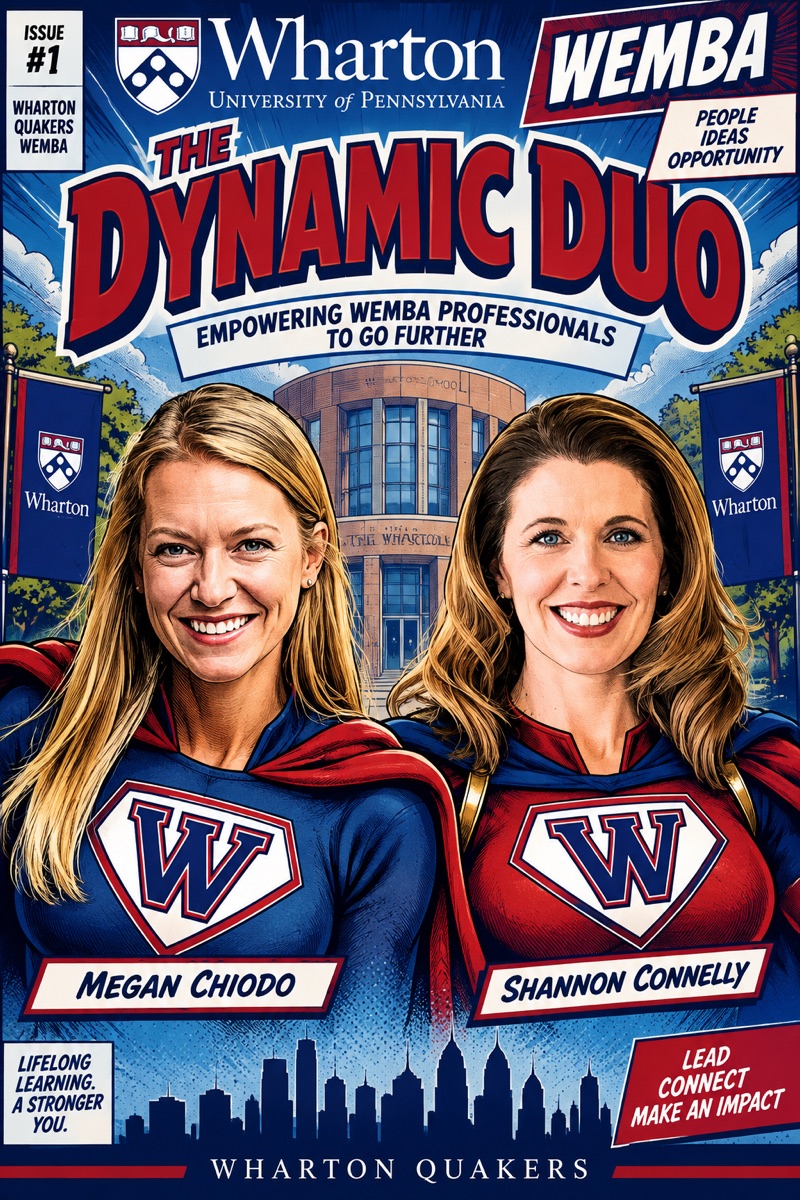
Your WEMBA Dynamic Duo
Fifteen years ago I went from teaching kindergarten in Bed-Stuy to business school, and it was my career team who helped me land at Apple and Google. So I know exactly what Shannons and Megans can do for you.
Megan ran the pre-session survey that shaped every minute of tonight - that's how we knew half of you are going for a bigger role somewhere new. And Shannon hosted, kicked us off and asked the questions on everyone's mind about executive recruiters (all while rolling with a last-minute Zoom switch). Your one action item above every prompt on this page: book time with them. They're in your corner. 🙌
4 big bonuses - all free, Whartonites 🎁
Courtesy of Shannon, Megan and your whole career team. (Samir, Jasmine and Angela: send me a message on LinkedIn - I'm the rare user who always checks my inbox - and your makeovers are on the way.)
Connect with me
Didn't get to ask your question tonight? Send me a request with a little note, and I'm happy to keep the conversation going whenever the time is right.
Connect on LinkedInGet a free profile makeover
Wanted one but didn't get the chance? Here's your second bite at the apple - the same makeover we did with Jasmine, straight from a LinkedIn insider.
Get my free makeoverEvery Career Masterclass
Not just tonight - every technique I've ever learned for navigating AI, LinkedIn and applicant tracking systems, free forever just for being a Wharton student. (Normally $299.) Give Shannon tons of love for this one.
Get lifetime accessProfileBot 4K
My own LinkedIn AI - the "one more thing." Tell it the CMO or CEO role you're going for, and it walks you through your headline, About section, top keywords and how to find alumni inside your target company.
Meet ProfileBot 4K"Make a big honking dent in the universe in everything you do next."Closing tonight's session, with a little help from Steve Jobs
LinkedIn isn't a random social network or a place to waste time. It's a portal to opportunity. Get reframed, get found and get referred, and you'll stand out for the bigger role you're going after. 🙌
So much love to Shannon and Megan for making this possible, and to Samir, Jasmine and Angela for sharing so generously. Here's wishing you a beautiful evening, from Philly to San Francisco.