America calls itself a meritocracy. But the job goes to whoever's best at the job of job searching.
That's no knock on the U.S. - there's an art and a science to it, and once you know the rules, you can play by them. Step one: find the employers who actually sponsor. Then win over the two things every American recruiter cares about: your skills (are you competent?) and your fit (are you warm, someone they want on the team?).
Who tends to get hired in America?
C) Candidates who are great at job searching. Jarif, Deep and Ankit all called it - and Jarif nailed the why: great job seekers know how to show recruiters how good they are at the actual job.
Here's the Rosetta Stone of American hiring: apply online and your odds are about 1 in 152. Get referred and they jump to 1 in 16 - roughly 10x better. Same candidate, different door.
Follow the Sponsorship Trail
Public data shows who sponsors. Alumni from your home country show you how.
Demo: Jones and drug discoveryGet Credit for Your Skills
Competence: beat the ATS by proving the skills you already have, in your own words.
Demo: Rebecca's ATS scoreGet Referred
Warmth: join the circle of trust and get referred anywhere - yes, even as an introvert.
Demo: Shanei and the FDATap any step to jump to its copy-paste prompts.
Public data tells you who sponsors. Private data tells you how to get sponsored.
Which firm has sponsored the most product managers in 2026 alone?
A) Google. Meta and Google were duking it out in the chat (Beatrice and Jing had it right). But the bigger lesson: by law, every U.S. employer reports its sponsorship to the federal government - so you can pull this data for your target role.
Jones and drug discovery, live
Jones is a PhD student in pharmacology and toxicology at UTMB Galveston, aiming for drug discovery. He's also a proud grad of the University of Ghana - and that turned out to be his secret weapon.
On the University of Ghana's LinkedIn alumni page, we found 10,000+ alumni living in the U.S. Almost by definition, most of them got here through grad school and sponsorship. They've walked his exact road.
Filter for drug discovery and up comes Clement at Arcus Biosciences. Then AI played email detective (first initial + last name, 93.4% certain), mutual connections like Kennedy and Nana could make the warm intro, and Jones's first question was exactly right: is Arcus hiring employees or interns? 🔥
Find sponsors - and the people who got sponsored
- Start with public data on MyVisaJobs: pick H-1B, see the top sponsors, then search by job title ("drug discovery," "scientist," "researcher") to get specific.
- Remember every other international student can see that data too. So go for private data: open your undergraduate university's LinkedIn page (IIT, University of Ghana, wherever you started) and click the Alumni tab.
- Filter for alumni living in the United States, then for your field. This is your tribe - people who've been in your shoes.
- Run Prompt 1 to find their work email format.
- Click Mutual connections and ask a friend of a friend for a warm intro. That social proof switches off the stranger force field.
- Click the three dots on the alum's profile > Save to PDF, upload it and run Prompt 2 to plan the conversation.
Email is the inbox every professional actually checks. AI finds the pattern in seconds.
Which teams sponsor, how the process really works - the insider details you'll never find on a careers page.
Recruiters only care about two things. The first one is decided by a robot.
What are the two things every American recruiter really cares about?
B) Your skills to do the job and your fit with the team. Tarifa, An and Susan herself all said B - and An nailed it: what skills can you bring to the company?
Harvard Business School researchers found the same thing around the globe: we want people who are competent (skills) and warm (fit). That duality is pretty much all you need to know about American hiring.
Rebecca's ATS score, live
Rebecca, also at UTMB Galveston, wants to be a senior pharmacoepidemiologist at a pharmaceutical company. We grabbed a real job description, pulled the top 15 keywords, saved her LinkedIn profile as a PDF and ran it through the ATS gauntlet - with a drum-emoji countdown from the whole state.
Her score: 58. Sounds scary, but Rebecca knew the sweet spot is well under 100 - nobody hires unicorns. When I was a recruiter, a 100% match who turned down the offer sent me back to square one, so 50-60% is often the real target.
The plot twist: Rebecca has experience in epidemiological modeling, study design and biostats. She just wasn't getting credit for it. The AI wasn't cheating her - her resume was. 💪
Score yourself before the robot does
- Find a job description you're excited about - it's the one source of truth for what your future boss wants.
- Run Prompt 3 to cut the noise down to the signal.
- On your own LinkedIn profile, click the three dots > Save to PDF. (Bonus: it's a handy stand-in CV at any conference.)
- Upload that PDF with the job description and run Prompt 4. Better to find the gaps before you apply than after you're rejected.
- For every red or yellow skill you really have, add it to your Experience section in your own words, with what you did and what happened.
Now you're not guessing and hoping and praying. You know what matters.
We're talking about algorithms, but this is really about agency - controlling your destiny instead of being blown around by the winds of fate.
Referrals aren't just for extroverts. They're for anyone willing to ask the right question.
Referred candidates are 7% of applicants - and 40% of hires.
We humans love social proof. A referral says "I trust this person," and that trust is the warmth half of the hiring equation. Meanwhile about 75% of job seekers keep applying online and wondering why nothing happens.
Shanei and the FDA, live
Shanei, another UTMB Galveston star (same department as Jones!), grew up in India and dreams of the FDA. She didn't know a single person there - and she was honest that as an introvert, reaching out feels hard.
The FDA's LinkedIn People tab is a directory of 17,000+ potential referrers - no hacking into servers in Maryland required. Filter for UTMB and you find 9 people on the inside, including Naidu, a regulatory scientific reviewer based right in Galveston, with a mutual connection ready to make the intro.
And Shanei's instinct was spot on: don't pitch, ask Naidu how he made the journey. Everyone wants to share what they've learned. 🙌
The referral playbook
- Open your dream employer's LinkedIn page. (Tip: sometimes it's faster to Google "[organization] LinkedIn" than to search LinkedIn itself.)
- Click People, then filter by your school - your UT campus or your undergrad.
- Pick an insider and click Mutual connections for a warm intro. Never cold if you can help it.
- In the chat, ask about their journey, not your elevator pitch. There's a whole field of psychology (generativity) about our urge to pay it forward.
- When they look at their watch, don't let them walk out of your life. Ask the ultimate question.
"This has been awesome. I know you have to go. If I could ask for one last piece of advice: if you were back in my shoes at [UTMB], trying to get into [the FDA] all over again, what would you be doing to get your best shot?"
It starts with empathy (they've been in your shoes), taps their generativity (they know what works) and it's specific. That's when you hear "We all got referred. Send me your CV." If you've truly hit it off, it's fine to just ask for the referral.
Not a real job title - your personal passion. Then click to set a job alert for that search.
This is the state of the art - and exactly what I'd be doing.
Smart questions beat a noisy pitch every time.
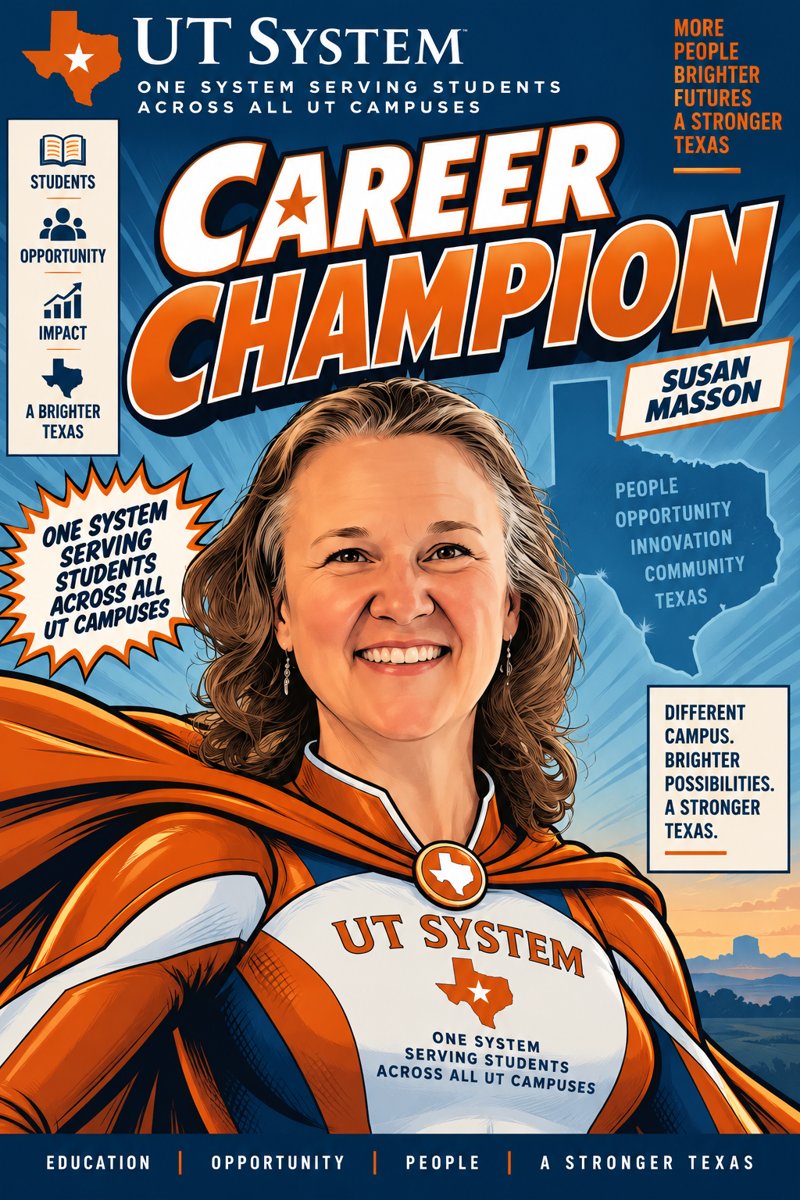
One Career Champion, serving every UT campus
I came to grad school as a former kindergarten teacher trying to leap into Silicon Valley, and I only made it because people like Susan were in my corner. She started her career in international education, then spent years helping international students with their job searches. So when she says "I see you, I feel you" - she means it.
Susan is forwarding the recording and every link to your campuses, and there are more sessions coming this year. Watch for them through your career services team - and keep an eye out for her UT System internships. 🙌
3 big bonuses - all free, Texas 🎁
Courtesy of Susan and the UT System. (Jones, Rebecca and Shanei: send me a message on LinkedIn - I'm the rare user who always checks my inbox - and your makeovers are on the way. Shanei, my offer stands: if I can ever introduce you to anyone at the FDA, just say the word.)
Connect with me
The burning questions usually show up right after the session - or in the shower the next morning. Send a request with a little note and ask anytime: tomorrow, a year from now, a decade from now.
Connect on LinkedInGet a free profile makeover
Didn't get the chance to volunteer today? Here's another shot at a free makeover, straight from the guy who led LinkedIn's education team - so you stand out, especially in a challenging moment.
Get my free makeoverCareerBot 3000
My own personal AI. Tell it why you came to Texas, what you want out of life and the skills you've built, then ask: how do I build that life in Dallas? It names top employers, ATS keywords and how to find UT alumni on the inside.
Try CareerBot 3000"The job search isn't a box to check. It's the pursuit of something bigger - a really great life."Closing today's session
In 2011 I was a grad-school intern at Apple, sitting in the audience for what turned out to be Steve Jobs' last big event. As sick and frail as he was, he still finished with his signature flourish - one more thing. So use these tools to go make your dent in the universe.
So much love to Susan, to Jones, Rebecca and Shanei for sharing so generously, and to every student from Galveston to El Paso. Be curious, be bold - and I'll see you on LinkedIn! 🧡