Think like a recruiter - then build your profile for the one who's searching for you
Everything today came from the other side of the table. Once you know what recruiters are juggling, what they type into LinkedIn Recruiter, and which candidate wins the last interview slot, every move on your profile gets obvious. Three steps, three live demos, three Trojans who went first.
How many resumes is the average recruiter juggling right now?
C) 10,000 - all at once. Howard called it ("the bigger number is the right one"). Two things collided: ever since ChatGPT, applications exploded - the average corporate posting now draws about 250 applications, up from roughly 100 back in 2022 - while the recruiters themselves keep getting laid off. Fewer recruiters, more AI-generated applications, and no way to tell who's real.
So recruiters are going where people are less likely to lie: your public LinkedIn profile, not your private resume. Which means they're searching for you right now - and the only question is whether you show up.
Get Focused
Recruiters search for a job title, not a degree. Find yours with ikigai, then learn from the Trojans already living it.
Demo: Grant's ikigaiGet Your Keywords
Headline, skills, experience: get the right words into the right sections so the algorithm pulls you to the top.
Demo: Kushal's makeoverGet Referred
A referral is a 20x advantage. Get one at any company in the world - even if you don't know a soul there today.
Demo: Kunjesh at TeslaTap any step to jump to its copy-paste prompts.
Tell recruiters where you're going, not just where you're sitting
If recruiters are searching LinkedIn for you, what are they searching for?
C) A specific job title. Eddie nailed it: a degree is nice, a school is nice, but the title is essential - are you focused on the role or not? The proof is the one screen no student ever sees: LinkedIn Recruiter, the $10,000-a-seat tool recruiters live in. (LinkedIn is the only place with all the world's talent in one spot - a goldmine for them, and critical for us to understand.)
Pull up your own headline. "Business student at USC" or "MBA Candidate at Marshall" says where you are today. What recruiters want is what you can do for them tomorrow.
See the original ikigai diagram - Grant read the book a year ago. Passion without pay won't build a life; pay without passion or skill won't last either. Start on the "you" side, then cross the chasm to the world of work.
Grant's ikigai, live
A former Target manager who's great at reading the room and adapting his message to whoever's in front of him - and who lights up when he guides people and they get better because of it. Ten job titles came back, and #10 jumped out: organizational development. A whole field for people fascinated by how others think and grow - well beyond the banker-or-consultant box we put ourselves in.
Then we went to the alumni tool, found Jim doing talent strategy and org development, and traced him all the way back to Marshall. 🔥
Find your path - and the Trojan who's walked it
- Run Prompts 1 and 2 to turn your strengths and passions into ten specific job titles - the language recruiters actually hire in.
- Open the Marshall alumni tool on LinkedIn (my team built it for exactly this crossroads) and search the role that intrigues you. Then search again on the USC-wide tool - more Trojans live there than at Marshall alone.
- Don't rely on Connect or Message (Premium or not) - it all lands in a LinkedIn inbox Jim checks maybe once a month. LinkedIn's dirty little secret: lots of users, very little usage.
- His email? Ten times a day. Use Prompt 3 to crack the company's address format - AI is a very good email detective (for PAX8 it was first initial + last name, 89% of the time).
- Beat stranger danger: click Mutual connections and ask for a warm intro. Marshall alumni don't hate you - they just don't know you exist yet.
- On the alum's profile, click the three dots > Save to PDF, then run Prompt 4 so the conversation is about you in the role, not just the role.
Works best in an AI you've been using for a while - it already knows you. No history yet? Tell it about yourself first.
You don't have to be an investment banker or a consultant just because it's business school. Let AI show you how big the world of work really is.
Now you're in the one inbox that actually gets read. Half of work in 2026 is staying on top of email - Yoyo knows.
Grant's instinct was great ("what's your day-to-day, what projects are you on"). This triangulates one step further: not "do you like your job, Jim?" but "am I going to like your job, based on what I love doing?"
Get the right words into the right sections
You're a recruiter facing 1.3 billion profiles. What do you filter for?
B) Keywords. Ethan's word was efficiency: 200 people took the same classes, but the one with the identical keywords is the one the recruiter wants. Keywords take a recruiter from 1.3 billion profiles to the top three candidates. The most important keyword is the job title; the next most important are the skills.
And the people who rise to the top aren't just the ones with those keywords anywhere - they have the most important keyword in the most important section: the headline. It's capped at 220 characters, which makes it harder to game, which makes it a more authentic signal, which is why the algorithm weights it most.
Kushal's makeover, live
Target: classic management consulting. First we searched "strategy consultant" and looked at the top results - Michelle, Joshua, Megan, Jonathan - and the pattern was hiding in plain sight: every one of them had it in the headline. Kushal had never been a consultant, so he used the workaround: "passion for management consulting," "seeking management consulting roles." Whatever flavor you like, you have to hang that flag out, or you're invisible.
Then the skills gap. The source of truth isn't People - it's Jobs, where recruiters list exactly what they need. Prompt 5 pulled the ten skills out of a McKinsey-style generalist posting; Prompt 6 ran them against Kushal's own profile PDF. Drumroll in the chat (Jay's oil drum, Alicia's GIFs)... he was already crushing commercial analysis, financial analysis and client management.
Missing: leading a team, coaching people, recommending to senior leadership. Had he done all three? Yes. Why no credit? "Because I didn't put them on my LinkedIn." The robots aren't cheating us - we are. Which means we can fix it. 💪
Your profile makeover, step by step
- Search LinkedIn for the exact title you want to be found for. Study the headlines at the top of the results - that's the pattern the algorithm rewards.
- Put that title in your headline. Not a consultant yet? "Seeking strategy consulting roles" works. Just never leave it at "MBA Candidate."
- Go to Jobs, open a real posting for that role, and run Prompt 5 to pull the ten skill keywords recruiters are filtering on.
- On your own profile: three dots > Save to PDF. Upload it and run Prompt 6 to see which skills you're missing.
- For every missing skill you've actually used, write it into the Experience section yourself - with the real story behind it.
- Match the same keywords in your About section and your top Skills, then rewrite the first two lines of About with the template below.
Our eyes were built for the Serengeti, not for reading job descriptions. Large language models were trained on every one ever written - they see the pattern instantly.
The most important question of your career. Do the drumroll, then get credit for what you've already done.
Kushal called it: "It doesn't know exactly what I did, so it could stretch the truth, and I wouldn't be able to explain it in an interview." Exactly. Skip it.
The About section template (from the chat)
- Line 1: a clear statement of why you belong in this field and what you're focused on - the title and keywords front and center.
- Line 2: one specific, impressive thing you've done that gives a recruiter confidence they're choosing the right person.
Recruiters see only those two lines before "...see more" - and most never click it. Make them count for the human; let the rest carry the keywords for the algorithm.
Give yourself your own luck
One interview slot, three equal candidates. Who gets it every time?
C) The one who was referred. Every single Trojan said C. Joshua explained why: a referral gets flagged by a current employee, so in a pile of thousands it gets noticed, and it builds trust before anyone's read a word. It doesn't guarantee the interview - but it changes the odds completely.
Back in 2016, a referral made you 10x more likely to get the interview than applying online. Joshua guessed it's grown since - and it has doubled. A 20x advantage on a life-changing decision, for a 30-minute coffee chat with an alum. The ROI is off the charts.
Kunjesh breaks into Tesla, live
Dream company: Tesla. People he knows there: zero. Does he still believe he can get a referral? "Maybe through coffee chats." That's the whole mindset - it isn't about already having connections, it's about building your own luck. In 2026 the #1 thing holding job seekers back is loss of hope. The savvy ones say: I can't control the economy or AI, so I'll focus on what I can do.
Every company page on LinkedIn has a People tab - a directory more complete than the one on Tesla's own servers. 92,000 Teslas became 329 Trojans (filtering for USC, not just Marshall), then a 2nd-degree filter found Colin in indirect procurement, Marshall '25 - with Eric and Stephen as the mutual connections who can open the door.
Then the call. Kunjesh's plan was an elevator pitch plus questions - but nobody wants to be pitched at dinnertime. What does every human love to talk about? Themselves. So: "How did you go from USC to Tesla? What did Marshall teach you that opened doors? What do you wish you'd known?" For every alum alive, that's catnip. 🐱
The referral playbook
- Open the company's LinkedIn page and click People. Filter by school - USC first, then Marshall - and by 2nd-degree connections.
- Pick an alum and click Mutual connections. Ask a mutual for a warm intro (a short forwardable note, cc you). Social proof beats cold outreach every time.
- On the call, no elevator pitch. Ask about their journey: USC to the company, what Marshall taught them, what they wish they'd known.
- When they say "I've got to run," ask the ultimate question below. Nine times out of ten the answer is "get a referral" - and because they brought it up, they can offer to put your CV in.
- Apply early and get referred - they are not either-or (see Kanishk's question).
"If you were back in my shoes - back at USC, trying to break into Tesla all over again, knowing what you know now - what would you be doing to get your best shot at an interview?"
It's deeply human: they've been in your shoes, they know what it takes, and you've made it easy to share. In my experience the answer is "I was referred - the whole company was referred - you've got to get a referral." Then: "Send me your CV."
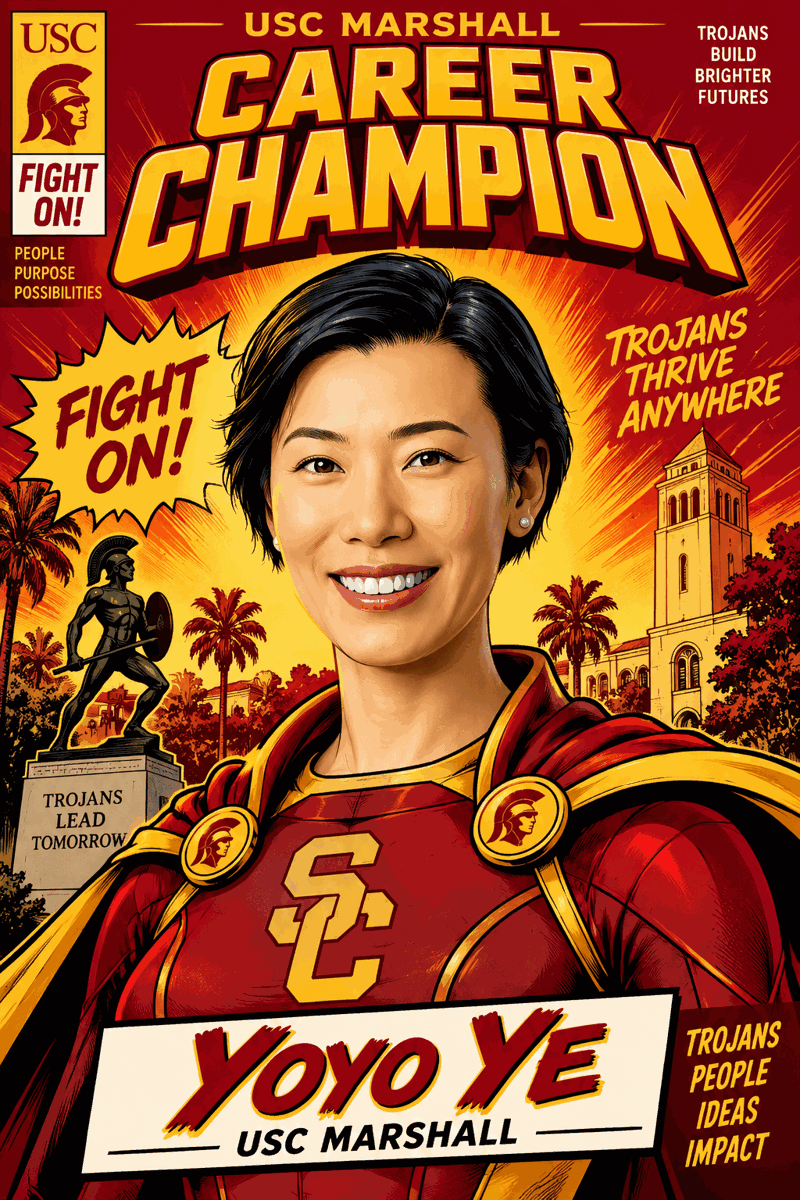
Your real superhero wears cardinal and gold
Fifteen years ago I walked into business school as a kindergarten teacher from Brooklyn, and walked out with offers from Apple and Google - because of career coaches exactly like Yoyo. Today she hosted, rallied 105+ Trojans before the undergrads even showed up, asked the question every MS student was thinking, and was there with Ella, Ian, Anneli and Professor Greg Patton every step of the way.
So here's the one action item I'd put above all the prompts on this page: book time with Marshall Career Services this week. They'll help you see your strengths through their eyes - the part no AI can do. (And Yoyo, enjoy the Bay Area with the family next week - the coast drive is the best part.) 🚗
Book time with Marshall Career Services3 big bonuses - all free, Trojans 🎁
Courtesy of Yoyo and your Marshall Career Services team. (Grant, Kushal and Kunjesh: send me a message on LinkedIn - I'm the rare user who always answers - and your copy of the book heads straight to LA. Kunjesh, the Tesla intro offer stands too.)
Connect with me
A question tomorrow, a year from now, or a decade from now? Send a request with a little note. Just like Yoyo, I'm always here to support you.
Connect on LinkedInGet a free profile makeover
Didn't win one today? Get the same makeover we did with Kushal - from the guy who led LinkedIn's education team. Straight from a LinkedIn insider.
Get my free makeoverProfileBot 4K
In honor of the summer of 2011 and Steve's last "one more thing" (the day Siri launched): my own AI. Tell it "I want to be a product manager, but I'm coming from a different background," and it walks you through the whole narrative - a clear headline, a winning About section, the right keywords, and how to find USC Marshall alumni inside Google. Free for every Marshall student.
Meet ProfileBot 4K"For the first time in history, I'm going to talk to my computer, and my computer is going to talk back to me."Steve Jobs, October 2011 - the last keynote he ever gave, and the first day of Siri
I was an intern at Apple that summer, and I thought it was the most important summer of my life. It turned out to be far more important for Apple: the last summer Steve ever worked there. As sick and frail as he was, he still got on that stage, still gave the speech, and still finished with his signature flourish - one more thing. So here's mine: LinkedIn is not a social network. It's a portal to opportunity, if you tell your story right. Use it to find your ikigai, and then go make a massive dent in the universe with this one precious life. 🙌
So much love to Yoyo and the Marshall team for making this possible, and to Grant, Kushal and Kunjesh for sharing so generously. Good luck against Washington this weekend - and in the game of life. Fight On! ✌️