The Pareto Principle of job searching
Your pre-course survey said it all: almost every one of you already uses AI for your resume, but only a handful use it for networking or LinkedIn. That's exactly backwards from where the leverage is. You don't need every AI tool or every trend - just the four techniques that drive almost all of the results. Here they are, in the order you'll use them.
Beat the ATS
Think like the algorithm: find the 10 keywords you're judged on and get credit for the ones you already have.
3 promptsGet Referred
Referrals are a 20x advantage. Find the Stanford insider at any company, reach the inbox they actually read, and ask the magic question.
3 promptsFind Your Future Boss
The hiring manager is the MVP. Two magic words find them, and AI translates their job description into the pain you can solve.
3 promptsAce the Interview
Be the Sandy Cheeks of candidates: competent and warm. Forecast the questions, tell STAR stories, and practice with real feedback.
3 promptsTap any step to jump to its copy-paste prompts.
Think like an ATS - and get credit for what you already know
You're applying for your dream role and keep getting rejected. Why?
A) Your resume didn't fit the role. Format matters, but lack of fit sinks far more job seekers. Back when I was a recruiter at Teach for America we had way too many candidates and way too few people to review them, so we did what EMTs do every day: triage. Score every application against the job description, focus on the best fits, auto-reject the rest. Cold? It's common sense - you'd do the same.
The good news: an ATS doesn't judge you on every word in the job description. It judges you on a handful of keywords. Find those, and you've found the bar.
The reveal, every single time
Here's what happens when you run the three prompts below against a real job description: you get a short list of skills you're "missing" - and then you realize you've actually done half of them. They're just not on your resume where the algorithm looks.
That's the whole game. Not inventing skills. Getting credit for the ones you already have, in the language the ATS is searching for. 🔥
Pass the algorithm in five steps
- Start with a job description you're actually excited about. (No favorite yet? Prompt 1 will get you one to be judged against.)
- Run Prompt 2 to cut the JD down to the 10 keywords that actually matter - AI has read millions of these, so it sees the pattern.
- Upload your resume (or your profile PDF) in the same chat and run Prompt 3 for the moment of truth.
- Go through the gaps one by one. Have you really done it? Then add it to your Experience bullets, in your own words, with the keyword the ATS is looking for.
- Haven't done it? Now you know exactly what to go learn - a project, a class, a side gig - instead of guessing.
Or grab a job description you're already excited about. Either way, start with the JD: it's how you check the fit on your side, and how recruiters check it on theirs.
An ATS doesn't screen you on every word, only the most important ones. Now you know where the bar is instead of guessing.
Attach your resume (or your profile PDF) with the 10 keywords in the same chat. For the first time, you know exactly how you're being judged. Drumroll optional.
Find a referral at any company - the warm intro that beats a thousand applications
Which application channel makes you 10x more likely to be hired?
C) Getting referred. A referral means a real human has vetted you, instead of an ATS screening your resume. Back in 2016 there was already a huge chasm between the online strangers and the handful of people inside the circle of trust.
Then the follow-up: has that advantage gotten bigger or smaller since ChatGPT? Not just a little bigger - 20x. When everyone can generate a perfect application in seconds, trust is the only thing that can't be faked. If you want to break through, this is where you spend your time.
Why "any company" is not an exaggeration
Stanford has one of the most powerful alumni networks on the planet - and LinkedIn makes every bit of it searchable. Open any company's page, click People, filter for Stanford, and there's your insider. Even at a 50-person startup, there's usually a Cardinal in the building.
The mistake almost everyone makes is messaging them on LinkedIn and waiting. The inside stat that shocks every room: the average LinkedIn member checks in about once a year. So we go where they actually read - their work inbox - and even better, through someone they already trust. 🔥
From stranger to referral in six steps
- Open the company's People tab on LinkedIn and filter for Stanford to find your Cardinal insider (or start at the alumni tool and filter by company).
- Don't rely on LinkedIn messages - busy people aren't active there. Run Prompt 4 to crack the company's email format instead.
- Subject line: "Fellow Cardinal, would love to learn from your experience." Then send the message in Prompt 5 - focused on learning, never on getting a job.
- Even better: click Mutual connections on their profile and ask for a warm intro. Being introduced engenders way more trust than "I'm a stranger, but trust me."
- In the conversation, get specific: how did you go from ICME to this team? What did you learn? What do you wish you'd known in my shoes?
- When they have to run, ask the magic question in Prompt 6. Alumni get honest fast - and when the referral is their idea, "send me your resume" follows naturally.
It comes back in seconds: first name dot last name, first initial plus last name, whatever it is. Now you're in the one inbox that actually gets read.
Not "random Stanford student wants a job." A heartfelt note an alum can get behind - and if a mutual connection is making the intro, it lands on top of their social proof.
Starts with empathy (they've been in your shoes), taps generativity (they know what works), and it's tangible. In my experience alums say "you've got to get a referral" - and then offer one.
Find the hiring manager before you ever apply
Recruiter, hiring manager or referrer - who's the MVP of hiring?
B) The hiring manager. Everything funnels to them. In grad school I fetishized recruiters (those circles of death around the corporate rep at the career fair). But a recruiter is a mercenary juggling 40 roles. The hiring manager is their client, your future boss, and the one person who can change your life with a single yes.
The catch: nobody's business card says "hiring manager." It's a hat someone wears for one moment in time, so you can't search for the title. You have to search for the signal.
Two magic words
Search "recruiter at Google" and you get the face of the company. We want the clients behind the scenes. So search LinkedIn for "I'm hiring" plus your space - machine learning, data science, quant - and switch from People to Posts.
The recruiters vanish and the engineering managers, heads of data science and research leads appear, posting about their own open roles. Then AI turns their job description into three burning pain points and matches them to your resume. Your message writes itself. 🔥
Reverse-engineer the job in five steps
- On LinkedIn, search "I'm hiring" plus your space (machine learning, data, optimization) and switch from People to Posts. Sort by Latest. Hiring managers post about their own roles; recruiters post generic ads.
- Pick a real role from a real future boss and copy the job description.
- Run Prompt 7 to translate the bullet points into the three pain points behind the hire.
- Run Prompt 8 to find the three stories from your own resume that prove you can solve them.
- Write the message yourself with Prompt 9 as the skeleton: a shared hook, their challenges, your examples. Then send it (or better, get introduced first).
For an ML role it might surface model latency, messy training data and a product team that can't ship fast enough - the themes to build the whole message around.
This is where AI helps you cross the chasm: from "I understand what they're facing" to "here's the proof I've done it before."
They don't expect you to know everything about their business. The message proves one thing: of the thousand people who applied, you were the one brave enough to find them and speak their language.
Win the competence battle and the warmth battle
You're hiring for your own company: Patrick, Mr. Krabs or Sandy?
C) Sandy Cheeks. Patrick is lovable but inept, Mr. Krabs gets results but only for himself, and Sandy is hardworking, dependable and a great teammate. (I used to ask this about The Simpsons until a room full of grad students told me I was old.)
With their pick of the world's talent in 2026, employers won't settle for nice-but-ineffective or strong-but-toxic. They want the sweet spot - and the interview is exactly where the human algorithm kicks in. The research is clear: people judge warmth first, then competence. You need both.
Competence is prep. Warmth is a choice.
The competence half is the part ICME students are built for: understand the company, forecast the questions, and have a crisp story ready for every one. That's exactly the trick I used when I was hiring at Google - flip the job description into the ten questions I was going to ask.
The warmth half is where technical candidates lose offers they should have won. Not because they're cold - because they never practiced the human part out loud. Feedback fixes that, fast. 🔥
Prep like a hiring manager in six steps
- Understand the company: run Prompt 10 for a SWOT analysis so you know what they're actually fighting for.
- Understand the role: paste the job description into Prompt 11 and forecast the ten most likely questions.
- For every "tell me about a time" question, build a STAR answer: Situation, Task, Action, Result. Prompt 12 does the first draft from your resume - AI is a bad writer but a great editor.
- Make it yours. Edit the story so it sounds like you, not like a bot.
- Practice with feedback: schedule a mock interview with Tanya and the ICME career team.
- Night before and the office is closed? Open Yoodli, pick the role and interviewer, and get automated feedback on filler words, pace and delivery - 24/7.
Strengths, weaknesses, opportunities, threats - the easiest framework for understanding what's going on inside the building before you walk in.
Each hiring manager is a special snowflake with specific pains. Same bullet points as Prompt 7, now framed as the questions they'll ask you.
It takes what you actually did and puts it into the heroic flow where the interviewer leans in and says "you're pretty darn competent." Then edit it until it sounds like you.
Your real superheroes: the Dynamic Duo
I get to visit for one afternoon. Tanya and Salma are in your corner for the whole journey.
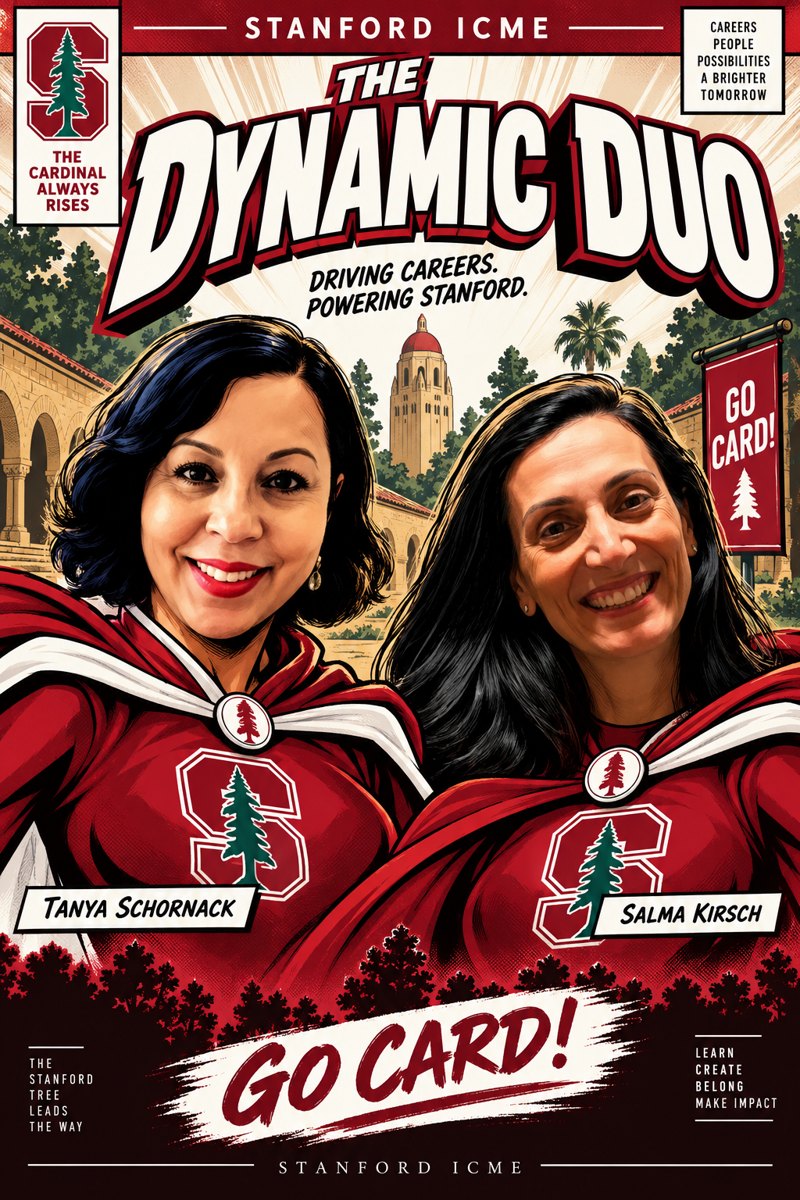
Tanya built CME 299 so that ICME and Statistics grad students don't just graduate with world-class technical skills - they graduate knowing how to get hired. She surveyed every one of you before the quarter started, ran the room today, and with Salma is the team to book time with for the thing no AI can give you: real feedback on your resume, your outreach and your interview stories.
If you're not booking time with Tanya, Salma and ICME Career Services, you're leaving your biggest advantage on the table. Go Card! 🌲
3 big bonuses - all free, Cardinal 🎁
Courtesy of Tanya, Salma and ICME Career Services. (If you braved the hot seat today, send me a message on LinkedIn - I'm the rare user who always answers - and your profile makeover is on the way.)
Connect with me
A question tomorrow, a year from now, or whenever the time is right. Send a request with a little note - I always stay on top of my LinkedIn, even if no one else does.
Connect on LinkedInGet a free profile makeover
Didn't win one in the hot seat? Here's your second chance - from the guy who led LinkedIn's education team, so you stand out to the best recruiters in your field, today and forever.
Get my free makeoverMeet CareerBot 3000
My own AI career concierge. Tell it "I'm finishing my ICME master's and want to land a machine learning role at a company that actually ships" - lead with your resume - and it maps the whole roadmap: the roles that fit, the employers to target, the keywords, and how to find Stanford alumni who can open doors.
Meet CareerBot 3000"One more thing."Steve Jobs
In 2011 I was a lucky MBA intern at Apple who got to see Steve Jobs' final presentation - so I end every session with his flourish. Here's mine for ICME: the biggest mistake of grad school is going through the motions. Just here for the degree, just here for any old job. Instead, treat Stanford as your launchpad. If you ever wanted to do something awesome in the universe, this is your moment, this is your time, this is the place to make it happen. Keep your eyes on the stars, and make a big honking dent in the universe. 🙌
So much love to Tanya, Salma and ICME Career Services, to everyone who braved the hot seat, and to every ICME and Statistics student who showed up today. Have a beautiful evening on the Farm - and Go Card! ❤️🌲