Watch the full session
Or open it on YouTube.
Recruiters are drowning - so make it easy for them to find you
AI makes it easier than ever to apply, so applications are exploding. At the same time, recruiters are often the first people cut in a layoff. Fewer recruiters reading more applications - and many of them feel fake. So recruiters are going where talent is harder to fake: your public LinkedIn profile. Tonight we worked through the three steps that get you found and hired, with three live demos.
How many resumes is the average recruiter juggling at any given time?
C) A whopping 10,000. Nan nailed it: every LinkedIn posting shows hundreds or thousands of applicants, and recruiters manage more than one job at a time. And it's not just LinkedIn - it's everywhere.
My friends who are still recruiters tell me it has never been harder to find someone real. And because people are less likely to stretch the truth on a public LinkedIn profile than a private resume, that's where recruiters are looking.
Find Your North Star
Turn your strengths and passions into real job titles with ikigai - then learn from the Pitt alumni already living them.
Demo: Pranav's ikigaiGet Found
Put your target title in your headline, find your keyword gaps with AI - then tell your story in your own words.
Demo: Basky's makeoverAce the Interview
Win the human algorithm with warmth and competence: predict the questions, tell STAR stories and practice day or night.
Demo: Keith at GoogleTap any step to jump to its copy-paste prompts.
Recruiters search for job titles - so you need one
When recruiters search LinkedIn for you, what do they search for first?
C) A specific job title. Pranav explained why: everyone could have the degree or the school, but recruiters are looking for a certain kind of skill set and a certain kind of work. Degree is nice. School is nice. Job title is essential.
That's the LinkedIn Recruiter screen - not free LinkedIn, not even Premium. Every recruiter pays for it because no other platform has all the world's professionals in one place.
See the original ikigai diagram. As Pranav put it: what you love, what you're good at, what you're paid for and what the world needs - where they all overlap is your purpose.
Pranav's ikigai, live
Second-year Katz MBA, six years in sales management. His superpowers: people, networking, convincing and negotiating - and spotting what others miss. His motivator: helping people get inspired by asking them the right questions.
Ten titles came back, and one jumped out: Strategic Partnerships Manager.
Then the Pitt alumni tool (filtered for Pitt and Katz) surfaced Anirudh doing strategic partnerships at Meta - who turned out to be one of Pranav's close friends. That's the power of the Pitt network. 🔥
Find your path - and the Pitt alum who's walked it
- Run Prompts 1 and 2 to turn your strengths and passions into ten specific job titles - the language recruiters actually search.
- Pick the title that intrigues you most and search it on LinkedIn, filtered for the University of Pittsburgh.
- The hack: also filter for your professional school (Katz, Swanson, SCI and so on). At LinkedIn we split those from the main university page, so search both.
- Think twice before Connect, Message or buying Premium. LinkedIn has tons of users but very little usage - your alum may check it every couple of months.
- Go to the inbox they check 20 times a day: email. Prompt 3 cracks the company's format.
- Beat stranger danger: click Mutual connections and ask for a warm intro. Pitt alumni don't hate you - they just don't know you exist yet.
- On the alum's profile, click the three dots > Save to PDF, upload it, and run Prompt 4 so the conversation tests whether you would love their role.
Best in an AI you've been using for a while - it has a tremendous record of how you think and what you do.
Recruiters aren't looking for "motivators" or "negotiators." They're filling specific roles - so speak their language.
At Meta it came back as first name @meta.com (or @fb.com). Then pair it with a warm intro so you're not just a name they don't recognize.
Pranav's instinct was classic Venn diagram analysis: what you bring, what the role needs, and whether your goals overlap. AI helps you get to the heart of it.
The cold email that actually gets opened
- Subject: Fellow Katz student looking to learn from your expertise
- Body: Hi Anirudh, I'm a current Katz student at a bit of a career crossroads, trying to decide whether to go into strategic partnerships or a different role. I can tell you've navigated this journey. I know you must be incredibly busy, but if you have even 10 minutes next week, I'd love to learn from your expertise - it would help me tremendously as I figure out my next steps.
Your headline is where the action is
1.3 billion profiles, 1.3 seconds each. How does a recruiter know who's a good fit?
B) The keywords you list. Ogechi nailed it: keywords speak to your skills, your background and even your passion - and they show you know the lingo of the field. Classes and GPA just don't carry that signal.
Search "project manager" in LinkedIn Recruiter and the people at the top have the most important keyword - the job title - in the most important section: the headline. It's shorter than a tweet, so it's harder to game, a more authentic signal, and the algorithm gives it the most weight.
Basky's makeover, live
Mid-career in banking and treasury, now earning a master's in data science - and aiming for Treasury Director. We searched the title on LinkedIn and every top profile had the keyword in the headline.
The catch: Basky works at TD, so a big headline change (or the green Open to Work badge) could tip off his boss. The fix: Open to Work > Recruiters only - your signal goes to recruiters, but it's not on your profile and LinkedIn scrubs it from recruiters at your own company.
Then the gauntlet: Prompt 5 pulled the job's skills and Prompt 6 graded his profile PDF. Treasury, liquidity, financial analysis, risk and stakeholder management all checked out. His homework: as he builds new skills at Pitt, get credit for them in his own words. 🙌
Your profile makeover, step by step
- Search LinkedIn for the exact title you want and study what the top results have in common - the most important keyword in the most important place.
- Put that title in your headline (with an honest prefix if you haven't done it yet). "Student at Pitt" is great - but tell recruiters what you can do for them next.
- Employed? Use Open to Work > pencil icon > Recruiters only. You can list multiple titles and multiple locations - great for full-time students, too.
- Open a job description you're excited about and run Prompt 5.
- On your own profile: three dots > Save to PDF. Upload it and run Prompt 6 - the moment of truth.
- For every gap you've genuinely covered (in a job, a class or a group project), write it into your Experience section yourself. Skills get you a little credit; Experience - with context - gets you so much more.
Job descriptions are boring and painful to read. But hiding inside those bullet points is the signal recruiters pay attention to.
Usually you've done more than the AI can see. You just don't speak "robotese" yet - so get credit for it.
Great for getting through the algorithm - right up until the interview.
Joao's question: an About section that isn't cheesy or long
- Sentence 1 - win the algorithm and the skim: "Need someone to fill this specific job? I'm your person."
- Sentence 2 - earn a stranger's trust: "Here's one amazing thing I've done that proves it."
Every section has two audiences: the algorithm (keywords) and the human recruiter, who gives you about six seconds and rarely clicks "see more."
Win the human algorithm inside your future boss's head
You're hiring: Patrick Star, Mr. Krabs or Sandy. Who would you rather work with?
C) Sandy. The whole chat said C, and Keith explained why (without ever really watching SpongeBob): Patrick isn't very competent, but Sandy is grounded and competent.
Researchers around the world keep finding the same two things: you have to be able to do the job (competence) and I have to want to do the job with you (warmth). Grad students often come across as really competent - but cold. That costs otherwise great candidates great jobs.
Keith at Google, live
Neuroscience PhD student aiming for data scientist roles (when I was at LinkedIn, we hired a ton of PhDs from every discipline). Competence first: the job description is a document your future boss wrote about their exact pain points. Prompt 8 turned it into interview gold - almost all behavioral questions.
So, STAR (Luis spotted it first). Remember The Odyssey this summer? Situation: lost at sea. Task: get home. Action: the Cyclops, the sirens. Result: home to Penelope. It's the hero's journey.
Then Yoodli, set to rude - Keith's pick. Simon the interviewer held my feet to the fire when I channeled Keith's "worst possible answer." In 2026, AI can do a lot of the analysis. Storytelling is what brings data to life. 🔥
Your interview game plan
- Paste the job description into AI and run Prompt 8 to find the pain points and predict the questions.
- Run Prompt 9 to rearrange your real experience into STAR flow - never let AI invent new content - then make it sound like you.
- Practice with the Pitt career team for expert feedback.
- Night before? Open Yoodli, pick the role and company, choose a friendly, blunt or rude interviewer, and rehearse until the warmth comes through.
- Keith, Pranav, Basky - and anyone else - share a Yoodli with me and I'll send back an interview makeover. (I'll be nicer than Simon.)
This Google team isn't looking for a random data scientist. They have specific challenges - and specific questions as a result.
AI knows STAR too. But the world's best story with the world's worst storytelling won't walk out with the offer.
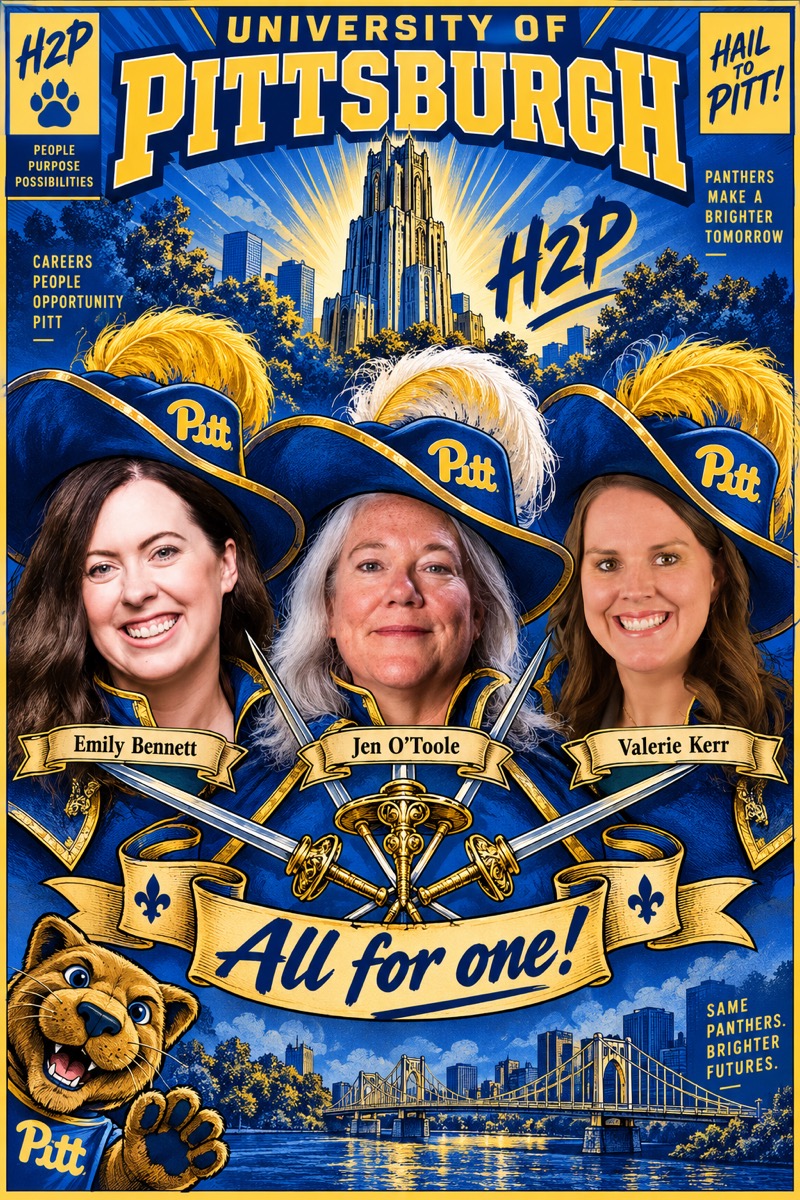
All for one - and all for Pitt grad students.
Before I ever landed jobs at Apple and Google, I was a former kindergarten teacher in grad school who needed people exactly like Emily, Jen and Valerie in my corner. Valerie dreamed this session up before heading off to her next adventure, and Emily and Jen carried it across the finish line for students from every school on campus.
So here's the one action item I'd put above every prompt on this page: book time with your career team. Practice your STAR stories, pressure-test your target roles, and let them help you find your North Star. Hail to Pitt! 🙌
3 big bonuses - all free, Panthers 🎁
Courtesy of your career team. (Pranav, Basky and Keith: send me a message on LinkedIn - I'm the rare user who always checks my inbox - and your makeovers are on the way.)
Connect with me
A question tomorrow, a year from now, whenever the time is right. Just like Emily and Jen, I want to be in your corner - and I want to hear what happens next.
Connect on LinkedInGet a free profile makeover
Didn't get picked tonight? Here's your second chance at the same expert review Pranav, Basky and Keith won.
Get my free makeoverProfileBot 4K
My own AI for LinkedIn. Whether you want to be a data scientist, lead strategic partnerships or become a director of treasury, it helps with your headline, About section, the keywords that matter, a cover photo - even getting referrals from Pitt alumni.
Meet ProfileBot 4K"Don't just collect degrees and check off boxes. Leave a big honking dent in the universe."Closing tonight's session, with a nod to Steve Jobs
In the summer of 2011 I was a grad student interning at Apple, sitting in the audience when Steve gave what turned out to be his last big talk - and, as sick as he was, he still closed with his signature flourish: one more thing. LinkedIn isn't a random social network. It's how you tell the world the story that helps it find you. 🙌
So much love to Emily and Jen for making this possible, to Pranav, Basky and Keith for sharing so generously, and to every Pitt student at every Pitt school for bringing big-time energy. Hail to Pitt! 💙💛