Forget the AI algorithm. Interviews run on the human one.
The algorithm that decides your offer runs in the mind of every hiring manager in the world. And it comes down to two questions - which means MBAs who only flex their brains lose out to the ones who also come across as amazing teammates.
You're hiring. Patrick Star, Mr. Krabs or Sandy Cheeks?
C) Sandy - a landslide, from Ethan, Blakeney and Mariah (with an exclamation point!). And Mariah McVey nailed the why: Sandy has real, demonstrated skills. Mr. Krabs is a little too money-motivated. And Patrick, while a great friend to SpongeBob, isn't always the most competent.
That's exactly what researchers found when they studied how people make these calls around the globe: competence (can you do the job?) and warmth (do I want to do the job with you?). Be the Sandy Cheeks of every interview for the rest of your career.
The first 5 minutes: PET
"Tell me about yourself." Passion, Evidence, Tie-in.
Demo: Kathryn's General MillsBehaviorals: STAR, with context
"Tell me about a time..." Bring them into your world, then the juicy details.
Demo: Ethan's NetflixCases: GAPS
"How would you...?" Goal, Audience, Pain, then Solutions.
Demo: Bernardo's AmazonThree kinds of questions, one human algorithm behind all of them. Tap any step to jump in.
"Tell me about yourself" isn't the appetizer. It's the entree.
When I was in your shoes, I obsessed over the trivia: golf balls in the Empire State Building, the deadly cases, the thank-you email. Then I started hiring MBAs at tech companies myself - and realized the only question that really mattered was the first one.
What share of interviewers make up their minds in the first five minutes?
C) Nearly half - 49%. Ethan, Blakeney and Bernardo all called it, and Ethan Guinn explained why from his own hiring experience: you can tell a lot from how someone presents themselves and handles that very first prompt. (Plus a little pop psychology - he's read Malcolm Gladwell's Blink.)
We evolved to make sharp first impressions - fight or flight. And those primeval instincts are alive and well in the corporate Serengeti of the cubicle farm.
Kathryn's opener, live
A PR pro - two agencies plus in-house at Hearst Magazines - weighing brand management at a CPG company (and wealth management). The setup: a brand manager interview at General Mills. And brand is all about differentiation: peel back the layers on Cheerios and it's the same product as the generic one three dollars cheaper down the aisle.
Passion: a lifelong, almost magnetic curiosity about other people - what they're hungry for and what they need. Evidence: at Hearst, pitching Good Housekeeping one way and Town & Country another, thinking through every layer from journalist to reader (a B2B2C model!). And from day one in travel PR, going deep on Napa Valley before she'd ever set foot in California. Tie-in: that same deep customer empathy built General Mills - and it's what will keep it relevant for the next century.
Her verdict on the finished version? "I'm sold." 🙌 That's the five-minute win: come across as the one who just gets it, while everyone else is saying "you're a super good brand and a lot of Darden alums have gone there."
The PET framework
- Use the three-paragraph essay structure from middle school: thesis, evidence, conclusion. Everyone can follow it - that's the competence.
- Open with what makes you fundamentally different from everyone else in the pile, not your timeline.
- Back it with one or two specific stories.
- Empathize with the interviewer: "If this is what you need, here's why I'm the answer."
- For brand roles especially, show the differentiation - don't just claim it.
An interview isn't a torture device. It's a crystal ball.
For a hiring manager, every interview is a chance to gaze into the future and imagine what you'd be like on their team. And one kind of question sees the future more clearly than any other.
Of three assessment methods, which is most predictive of future performance?
Most of the room went A. Noor Varjabedian went B - behavioral interviews - and nailed it. Her why: how you reacted in past situations predicts how you'll react in the future.
A clever MBA can learn to dominate a conversational interview or a case. The one thing you can't change is what you've actually done. Done well (what's called topgrading - digging into exactly what you did), behaviorals beat cases, puzzles and all that other nonsense. So recruiters will ask you a million of them: influencing a team, using data, all that good stuff.
Ethan's story, live
A former software engineer and technical project lead at a tech consulting firm who loves building things that delight customers - now headed for product management. Shooting for the moon: an internal team at Netflix. The question, straight from AI's read of a Netflix PM job: tell me about a time you had to align engineering, design, operations and other stakeholders who disagreed on product direction.
Ethan's first version dove right into the challenge. So we pulled back to paint the picture: a consultant - the new guy, the outsider - walking into a beehive of change at a telecom company in Seattle, handing a giant, messy application from one department to another. Then the juicy details: he interviewed users, mapped their workflows, and spotted a barely used database costing a fortune. Nobody believed it could go. So he built a prototype - and found the hidden pioneers through internal chats, clients and warm intros to build a coalition that took it to leadership.
His verdict on the finished story? "Sounds amazing. I'd hire you." 🔥 The essence of great product management isn't technical brilliance - it's brilliance with people.
STAR, without the curse of knowledge
- Avoid the curse of knowledge. You lived it, so you skip the backdrop. Your interviewer didn't.
- Details are everything. After a long day of interviews, the juicy specifics are all anyone remembers.
- Flex your relational skills, not just your own success. How did you win allies? How did you build buy-in?
- Find the real pain behind the job description - that tells you which stories to prep.
You can read the financials or ask AI for a SWOT. But the single source of truth - the cry for help from inside the company - is the job description. AI is a bad writer, but a great translator: it reveals the pain behind every bullet.
They're not testing your answer. They're testing how you got there.
Which is Google most likely to ask candidates today?
Noor and Ethan went C, Mariah went B. Trick question: none of the above! Hat tip to a fellow MBA, Laszlo Bock (Yale SOM), who ran people operations at Google. When Google checked, there was zero correlation between nailing those puzzles and being great on the job.
So companies are asking something much fairer: if we're hiring you to do this job, show us how you'd actually do it.
Bernardo's Amazon case, live
Bernardo is Brazilian, with a background in manufacturing and financial services, aiming for GM, finance and strategy roles in tech - starting with Amazon. AI's case: you're the retail manager for Amazon's home and kitchen category. Revenue is up 25% year over year, but profits are down 15%. Diagnose it and recommend a fix.
Goal: rebuild profitability - something is driving costs up. Audience: Bernardo's pick, the stay-at-home parent: more cooking and engagement with the category, and likely more wealth than the average customer. Pain: his insight from living in the US vs. Brazil - services are expensive here, so time and convenience are everything. Solution: a premium weekly bundle with Amazon grocery - everything the family needs for the week, plus the grater or garlic press to cook it.
Bernardo, you made Brazil proud. 🇧🇷 We can't change tariffs or the macro environment - but we can change the customer mix.
The GAPS framework
- Go into respect mode, not answer mode. "Do you mind if I get organized to give you a really thoughtful response?" No real employee solves these on the spot.
- Start at the top. My LinkedIn mobile app example: the goal is usage - it drives valuation and monetization.
- Choose an audience that fits: not students (they don't use LinkedIn daily), but salespeople, who live and die on it.
- Feel their pain: sales is super hard in 2026.
- Only now, ideas. Wherever you land, you've built a logical suit of armor.
Swap in your own company and role - consulting, finance, tech, CPG, anything - then run each one through GAPS.
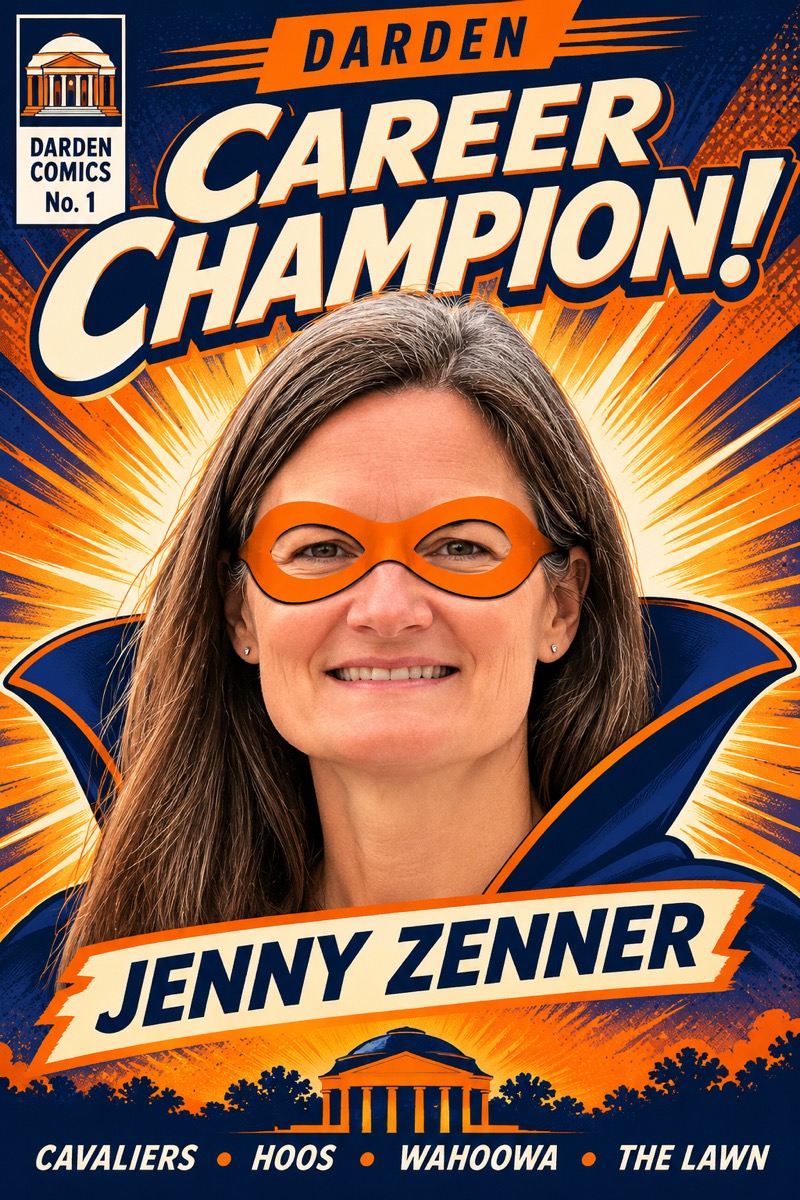
Two sessions in three days. One Career Champion.
Jenny hosted us twice this week - and today she did it the morning after an election, then jumped in with "spoon-feed it", a soundbite trick and the DCL question bank. Big love to Christy too, the other half of your Darden dynamic duo.
I walked into business school as a kindergarten teacher and walked out with offers at Apple, Google and Amazon because of the Jennys in my life. So the one action item I'd put above everything on this page: book time with her, and get real reps before the real interview. 🧡
4 big bonuses - all free, Hoos 🎁
Courtesy of Jenny, Christy and the Darden career team. (Kathryn, Ethan and Bernardo: drop me an email - your profile makeovers are on the way.) And catch Omar at next Tuesday's Tech Learning Series workshop!
InterviewBot 5000
My own AI interview coach. Paste in the job description and your resume, say what you want to practice (like "tell me about yourself"), and hit play. It runs the interview like a real one - then gives you feedback on exactly what matters: warmth and competence.
Try InterviewBot 5000Every career masterclass
Everything I've ever learned about interviews, AI and LinkedIn - full lifetime access, all for free, just for being a Hoo. Give Jenny some love for hooking you up.
Get lifetime accessConnect with me
A question the day before the big interview - or on your way to it? Send a request with a little note. Happy to be in your corner of the ring, just like Jenny.
Connect on LinkedInGet a free profile makeover
Wanted one but would rather not be in the hot seat? Totally get it - I would've been the MBA hiding in the back. Here's your makeover anyway.
Get my free makeover"You were in the hot seat - but you were the ones on fire."From today's session
Back in the summer of 2011, as an Apple intern, I watched Steve Jobs give what turned out to be his last keynote. Even then, he ended with his signature "one more thing." Every great story deserves that kind of finish - and so does every interview you walk into. So grab Jenny's coaching, grab these tools, and go make your mark on the universe. 🙌
So much love to Jenny and Christy, and to Kathryn, Ethan and Bernardo for being so brave. Wahoowa! 🧡