Recruiters are drowning - so make yourself the easiest Golden Bear to find
AI has made applying to one more job basically free, so the average posting now gets more than twice as many applications as it used to. At the same time, recruiters are the first people cut in every round of layoffs. Fewer recruiters reading more AI-generated applications means they're desperate for real talent - and because people are less likely to fib on a public LinkedIn profile than a private resume, LinkedIn is where they go looking. So the game is three steps: know where you're headed, get found for it, and get referred into it.
How many resumes is the average recruiter juggling at any given time in 2026?
C) A whopping 10,000. Jack called it with an exclamation mark - recruiters are absolutely flooded. They may not read all 10,000, but that's the pile they're digging through.
It's a double whammy: more applications than ever, and fewer recruiters than ever to read them.
Find Your North Star
Use ikigai and AI to turn your strengths and passions into a real job title - then find the Golden Bears already doing it.
Demo: Jack's ikigaiGet Found
Lead your headline with where you're headed, then let AI find your keyword gaps - and fill them in your own words.
Demo: Aashonee's makeoverGet Referred
A referral is now a 20x advantage. Build one from scratch at any company - even one where you know nobody.
Demo: Jack at OuraTap any step to jump to its copy-paste prompts.
Recruiters start with a job title - so you need one, too
What do recruiters search for first: a degree, a pedigree, or a job title?
C) A specific job title. Jack nailed the engineering logic: the most relevant skills for a job come from people who've been focused on that job - not the degree or the school.
So "I'm a student at Berkeley" is great - but it doesn't tell a recruiter the one thing they want to know: what you can do for them.
See the original ikigai diagram. The Japanese idea that a great career comes from harmony between who you are and what the world needs from you.
Jack's ikigai, live
His superpowers: test engineering and preclinical and bench testing for medical devices. His motivator: working on products he can actually see people using out in the world - real impact, not the ivory tower.
Ten titles came back, and the one that grabbed him was clinical systems - a pivot from his R&D test engineering roots.
Then a LinkedIn search for clinical systems plus Berkeley found his tribe - including Sonia, a digital health and clinical systems engineering exec and proud Golden Bear. 🔥
Find your path - and the Golden Bear who's walked it
- Run Prompts 1 and 2 to turn your strengths and passions into ten specific job titles. Recruiters don't search for "wants impact" - they fill specific roles.
- Search LinkedIn for the role that intrigues you, then filter to people who came from Berkeley. These are the Bears doing the work you're curious about.
- Skip the Connect-and-message. LinkedIn has 1.3 billion users and very little usage - if you don't hear back, it's not about you. They just never saw it.
- Go where they actually look: work email, the inbox every professional checks 10 times a day. Prompt 3 cracks the pattern.
- Beat stranger danger: click Mutual connections and ask a friend of a friend to go to bat for you. Now you're not a stranger.
- Before the chat, click the three dots on the alum's profile > Save to PDF, upload it with your own and run Prompt 4.
Not as sure about yourself as Jack is? Any AI tool you've been using for a while can reflect back strengths you don't give yourself credit for.
Instead of guessing where you belong, you get a guided path - and a real sense of how much great stuff you could be doing after Berkeley.
For Sonia's company, AI found the actual digital cookie-crumb trail: first name @ the company domain. That's the golden ticket.
Jack already asks about the day-to-day. This is the Vulcan mind meld version: your background, their background, and the role, all in one Venn diagram.
Tell recruiters where you're headed - not just where you sit today
1.3 billion profiles, 1.3 seconds. How does a recruiter know who's a fit?
B) The keywords on your profile. Aashonee answered like a true engineer: if a recruiter needs a project manager who knows HVAC, it'd be madness to search for anything but "project management" and "HVAC" - not classes or GPA.
And the most important keyword is the job title itself, in the most important section: your headline. It's only 220 characters, which makes it hard to game - so LinkedIn gives it the most weight.
Aashonee's makeover, live
The goal: product manager. Great photo, great headline, great school - and invisible for PM roles, because the title wasn't on the profile. A search for product managers proved the pattern: every name at the top had "product manager" right in the headline.
She'd interned in product development but never held the PM title, so calling herself one felt like lying. The fix is one word: "Aspiring Product Manager." ("Seeking" or "Exploring PM opportunities" work too.) Recruiters search the keyword, not the prefix. So where it says Berkeley, Berkeley, Berkeley - tell them Berkeley plus what.
Then the moment of truth: a 34% match against a real PM job description. But strategy, roadmaps, agile? She'd done them. She just wasn't getting credit - yet. 💪
Your profile makeover, step by step
- Search LinkedIn for the exact title you want - product manager, engineer, supply chain manager - and study the headlines at the top. That's the algorithm hiding in plain sight.
- Put your target title in your headline with an honest modifier: "Aspiring," "Seeking," "Exploring."
- Grab a job description you're excited about and run Prompt 5. Jobs posts are full of boilerplate, but the signal is hiding inside.
- On your own profile: three dots > Save to PDF. Upload it and run Prompt 6.
- For every missing skill you've actually used, write it into your Experience section in your own words. Skills matter, but recruiters trust what you've done with them.
Instead of guessing or hoping or praying, you get what you deserve: the truth about what you're being judged on.
A 34% today can be a lot higher tomorrow. The AI didn't cheat us - we cheated ourselves by not giving the algorithm what it needs.
Brad asked: what about my About section?
- Remember your two audiences: the algorithm that finds you, and the human recruiter who chooses you.
- For the algorithm: include a full list of your most important skill keywords.
- For the human: LinkedIn cuts it off after about two sentences, so make them count. Sentence one is what you can do for them - the role you can fill.
- Sentence two is why they should believe you - something impressive enough to knock their socks off.
Referrals aren't for the lucky few. They're for people who make their own luck.
Three equally qualified candidates, one interview slot left. Who gets it every time?
C) The one who was referred. Jack explained it: people will always trust a human they know over a website. And he guessed right that in the age of AI, when anyone can look great on paper, the gap has only widened.
Back in 2016, a referral was a 10x advantage. Today it's 20x. What if you spent even a fraction of your 20 hours of applications meeting alumni instead?
Jack breaks into Oura, live
Jack came back for round two and threw down the gauntlet: Oura, the ring company. He already had one contact there - so I sent that contact on a six-month expedition to Antarctica. Suddenly he knew nobody. Perfect.
Oura's LinkedIn People tab is a free directory of every employee from California to Finland. (Pro tip: sometimes Google searches LinkedIn better than LinkedIn does.) A Boolean OR in the school filter - Berkeley or Johns Hopkins, his undergrad - surfaced Olivia in research operations, with a mutual connection ready to intro.
Then the coffee. No pitch - Jack hangs up on telemarketers, too. Ask Olivia about Olivia: how she knows Kate, how she got from Berkeley to Oura, and what she wishes she'd known. That's generativity - every human loves to share what they've learned. 🙌
The referral playbook
- Open the company's LinkedIn page and click People. (Can't find the right page? Search Google for it.)
- Filter by school - and use OR to include every school you've attended.
- Pick an insider, click Mutual connections, and ask for a warm intro. Social proof drives intros just like it drives referrals.
- In the chat, lead with their story, not your elevator pitch.
- When they look at their watch, ask the ultimate question below.
- If they crack the door open, don't say "maybe" - follow up and send your CV right away.
"If you were back in my shoes, back at Berkeley, trying to break into Oura all over again, knowing what you know, what would you be doing to get your best shot at an opportunity?"
It's the opposite of AI and sales pitches: warm, empathetic, and generous. And that's when they get honest: "I got referred, half my team got referred - send me your resume and I'll put your name in."
You can't control the market. But you can control what you do with your time - and how brave you are.
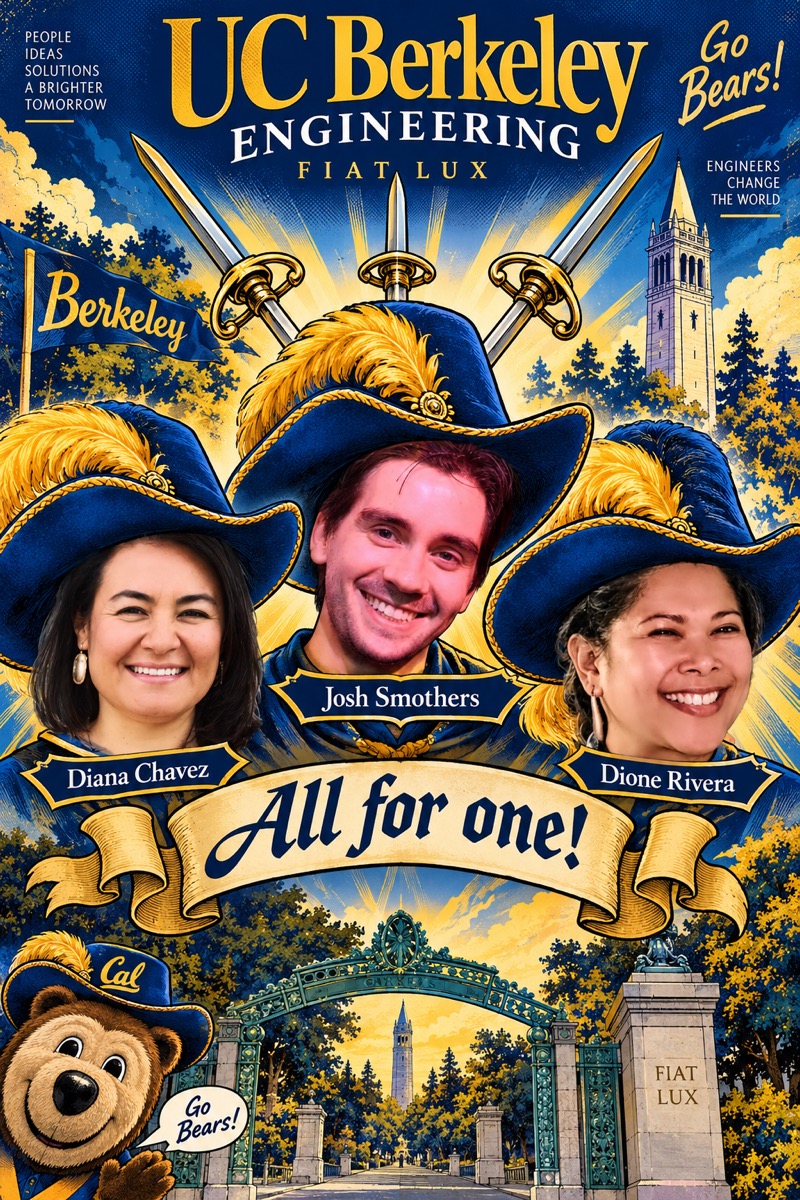
All for one - and one for every Golden Bear
Before Silicon Valley, I was a kindergarten teacher. It was the Dianas, Joshes and Diones in my life who helped me land at Apple and Google - so I know exactly what your career team can do for you.
Diana, Josh and Dione brought this session to life, wrangled the Zoom, and fed us your best pre-submitted questions. They're here for you not just right now, but throughout your career. Your one action item above every prompt on this page: book time with them. 🙌
3 big bonuses - all free, Bears 🎁
Courtesy of Diana, Josh, Dione and your whole career team. (Jack and Aashonee: send me a message on LinkedIn - I'm the rare user who always checks my inbox - and your makeovers are on the way. Jack, that's two: one for you and one for a friend. And if I can ever introduce you to anyone at Oura, just say the word.)
Connect with me
A question tomorrow morning, or on the way to an interview a year from now? Send me a request with a little note - happy to stay in touch.
Connect on LinkedInGet a free profile makeover
Wanted a makeover but not the hot seat? Here's your second chance - the same makeover we did live with Aashonee.
Get my free makeoverProfileBot 4K
My own LinkedIn AI - my "one more thing." Tell it "I want to be a product manager, but I've never been one" and it helps you brand yourself, tell your story, nail your keywords and cover photo, and find insiders for that 20x advantage.
Meet ProfileBot 4K"We're not here on this planet forever - but we're here just long enough to make a big old dent in the universe."Steve Jobs' spirit, as I closed today's session
LinkedIn isn't a random social network or a place to waste time. It's a portal to opportunity - if you know how to use it. Find your north star, get found, and get referred. 🙌
So much love to Diana, Josh and Dione for making this possible, and to Jack and Aashonee for sharing so generously. Fiat lux - and Go Bears! 🐻💙💛